Monday, April 7, 2014

Robots Help Autism and Schizophrenia

Kasper, the robot who helps autism by its repetitive behavior and words.

There are studies working with autistic children and robots in order to improve their social skills. Apparentely, robots not only focus only on visual contact but also on language: they produce repetitive sentences. It has been noted that children improve their communicative skills with this treatment. Kasper is the robot to help children with autism:


Bristol Post also reported that technology is improving to help patients with schizophrenia. The robot is called European iCup Robot and it interacts with patients. Read more here.

Can People with Autism Sing?


Yes, they can. Autism is a condition where the person feels isolated from the people around him, but they are totally connected to the world. They communicate with the world, but nobody to address to. This BBC documentary shows it very clearly:


Furthermore, autistic Kyle who has hardly spoken for his entire life stunned his family by singing and has now released his own album.

Kyle Coleman, 27, has released an album of original songs despite being a non-verbal autistic who has never uttered a full sentence and has been virtually mute for his entire adult life

Kyle Coleman, 27, was diagnosed with 'classic autism' aged three, but soon retreated into a world of his own, stopped speaking, and to this day has never uttered a full sentence.

Kyle was almost completely non-verbal until 2009 when his mother took him to a musical therapy session and he started singing along to his favourite songs in pitch-perfect harmony.


To read more about Kyle, click here.

Friday, April 4, 2014

What is Huntington's Disease?

An HD patient at Edgemoor Hospital in Santee, CA (photo by Mike Nowak)

 What is Huntington's disease?

Huntington's disease (HD) is a brain disorder in which there is progressive neurodegeneration leading to motor, cognitive, and psychiatric symptoms. Problems may develop in the following three areas: motor control (movement); cognition (thinking); and behavior. Speech and swallowing problems occur when the centers of motor or cognitive control are affected that cause muscle weakness or discoordination (chorea). Problems with memory, sequencing, new learning ability, reasoning, and problem solving also develop.
What are some signs or symptoms of Huntington's disease?

Problems with communication and cognition vary in nature and severity from person to person. Although there are things that may appear similar, no two people with HD are exactly alike. The following list summarizes problems that people with HD may experience at different stages of the disease. In many cases, a person with HD will experience the same areas of difficulty throughout the course of the disease, with severity varying from stage to stage.

Communication problems

  •     Muscle weakness, slowness, or incoordination of the lips, tongue, throat, and jaw (dysarthria)
  •     Disruption in programming and sequencing muscle movements for speech (apraxia)
  •     Diminished rate of control (talking too fast or too slowly)
  •     Poor voice quality (hoarse/harsh, breathy, volume too low or too high)
  •     Problems coordinating breathing and voice
  •     Word-finding difficulties
  •     Short length of utterance (person only responds with one or two words)
  •     Incorrect pronunciation of sounds
  •     Problems initiating conversation
  •     Getting "stuck" on certain words or phrases, repeating them often and at inappropriate times (perseveration)
  •     Repeating statements (echolalia)
  •     Difficulty monitoring pragmatic skills (turn-taking in conversation; reduced ability to maintain a topic or to switch topics appropriately)
  •     Inability to speak
  •     Difficulty beginning a word or sentence, with repetition of sounds (stuttering)
  •     Difficulty understanding information
  •     Difficulty reading and writing

Cognitive problems

  •     Diminished memory, immediate and short-term (long-term memory usually remains intact)
  •     Poor reasoning/judgment
  •     Reduced problem-solving ability
  •     Difficulty sequencing/organizing ideas
  •     Concentration problems/distractibility/short attention span
  •     New learning ability diminished
  •     Problems with numbers and mathematics computations

Swallowing problems

Swallowing problems (also known as dysphagia) are common among people with HD. Statistics have repeatedly shown that the number one cause of death among persons with HD is aspiration pneumonia. This can occur when food or liquid enters the airway rather than the esophagus during eating or drinking, and then forms a collection in the lung that can become pneumonia.

Swallowing problems associated with HD include the following:

  •     Impulsivity while eating
  •     Difficulty controlling rate of food or liquid intake
  •     Difficulty chewing food
  •     Delayed swallow reflex (doesn't t kick in even when food moves to the back of the throat)
  •     Holding food/liquid in the mouth
  •     Difficulty initiating a swallow
  •     Inability to swallow
  •     Incomplete swallows in which food or liquid is left in the mouth and/or throat
  •     Lack of coordination between swallowing process and breathing or speaking
  •     Need to swallow repeatedly for each bite/sip
  •     Chorea of the oral or pharyngeal muscles (tongue, lips, throat, esophagus)
  •     Drooling and/or spillage of food or liquid from the mouth

The following signs at mealtime may indicate swallowing problems:

  •     Coughing
  •     Choking
  •     Gurgly voice quality
  •     Wet sounding breathing
  •     Spillage of food and liquid from the mouth
  •     Frequent throat clearing
  •     Progressively slower rate of food intake
  •     Regurgitation of food after it has been swallowed*
  •     Food or liquid left in the mouth after swallowing
  •     Difficulty manipulating food or liquid in the mouth
  •     Frequent congestion*
  •     Frequent temperatures*
  •     Consistent or significant weight loss*

Signs marked with an asterisk (*) could be indicative of a serious, and possibly unrelated, medical condition and should be monitored by a physician. In general, if a person with HD experiences any one or a combination of the above problems, he or she should contact a physician and seek out a speech-language pathologist (SLP) for evaluation.


How is Huntington's disease diagnosed?

HD is diagnosed through genetic and other neurological testing. Tests can be done before a person has any symptoms to determine if they are carrying the HD gene.

What treatments are available for people with Huntington's disease?

Medications are typically prescribed by the person's doctor to manage symptoms. At this time, there is no cure or way to stop the progression of HD.

The SLP can be helpful at all stages of the disease. In early stages, he or she can assist with problem solving and developing strategies to help persons with HD compensate for some of the problems they might be experiencing. As the disease progresses, the role of the SLP evolves into helping preserve and maintain the person's highest level of communication and swallowing. Early intervention and involvement with professionals is best.

People can learn compensatory strategies more successfully during the early stages of HD and then apply them throughout the course of the disease.

The SLP can also evaluate a person's ability to use augmentative or alternative communication (AAC) devices and techniques, which can be as simple as an electronic device that speaks for the person. After determining a person's level of ability for using such techniques, the SLP begins to focus on personalizing the technique or method of communication.

For example, the SLP might work with a person with HD and his or her family to create a word/picture board tailored to the person's environment (whether it be a nursing home or private residence) and flexible enough to be carried around. If the person may benefit from an electronic device and appears motivated to use one, then the device can be made easily accessible.

The SLP can evaluate a person's swallowing function and make recommendations that involve positioning issues, feeding techniques, diet consistency changes, and education of the person with HD, family members, or caregivers. Special testing known as videofluoroscopy (or a modified barium swallow) can be done by an SLP and a radiologist to determine if a person is actually aspirating a particular consistency. This test provides an inside view of a person in the act of swallowing food or liquid and can be a useful tool in developing strategies for safe swallowing.


What can I do to help someone with Huntington's disease communicate?

Although alternative methods of communication are available, people with HD generally prefer to attempt verbal communication for as long as possible, even if their speech becomes hard to understand. The SLP and family members can often help by encouraging the speaker to:

  •     Speak more slowly
  •     Say one word at a time
  •     Repeat the word or sentence when necessary
  •     Rephrase the sentence
  •     Exaggerate the sounds
  •     Speak louder (taking a deep breath before speaking)
  •     Describe what heor she is trying to say if he or she can' t think of the word
  •     Indicate the first letter of the word
  •     Use gestures
  •     Keep sentences short
  •     Use alternative techniques such as word boards, alphabet boards, picture boards, or electronic devices

The following are some suggestions for the listener:

  •     Eliminate distractions (TV's, radio, large groups of people)
  •     Keep questions/statements simple
  •     Ask one question at a time
  •     Use yes/no question format as much as possible
  •     Pay attention to gestures and facial expressions/changes
  •     If you do not understand what is being said, don't pretend that you do. Ask for clarification, or repeat what you think was said in the form of a question, such as, "Did you say...?"
  •     Try to keep to familiar topics
  •     Encourage the speaker to use his/her specific compensatory strategies
  •     Allow enough time for the person to convey his/her message
  •     Most important, be patient with the speaker

There are also compensatory strategies for cognitive problems that can be implemented in the home. The following are some examples:


Problem
Strategy
Poor orientation to time and place
  • Keep a large calendar visible.
  • Display a large, visible clock.
  • Post signs on walls stating location.
Diminished memory
  • Post a schedule of daily routine.
  • Establish routines for all activities (e.g., place keys or glasses in same place daily).
  • Label cabinets and drawers.
  • Keep a memory log book like a diary in which the person with HD can write down and refer back to what he/she has done, with whom, and when.
  • Keep an appointment book for social events, doctor's visits, and other dates and occasions to be remembered.
Reduced problem-solving ability
  • The person with HD should discuss with a family member possible problems that could occur in the home. Solutions or steps to be followed should be anticipated, written down, and kept in an obvious place.
  • Follow these set guidelines for problem solving.


These are just a few examples of how a person experiencing cognitive problems can make life easier at home. An SLP can provide assessment, guidance, and further suggestions on the use of compensatory strategies.

How can I help someone with Huntington's disease who is having swallowing problems?
You can help by following these suggestions:
  •     Provide small bites and sips.
  •     Alternate bites with sips to help wash down the food.
  •     Make sure that the person is sitting as upright as possible; place pillow behind his or her head/neck to prevent head tilting backward.
  •     Control rate of intake, allowing enough time for previous bite/sip to be cleared. Look for rise and fall of larynx (Adam's apple), or lightly place two fingers on the person' s Adam's apple to feel it rise and fall, as a possible signal that swallowing is complete.
  •     Make sure the person swallows twice for every bite or sip to clear residuals from the mouth.
  •     Use gravies, sauces, and condiments with dry foods or solids whenever possible.
  •     Crush medications in applesauce if a person is on a pureed (blenderized) diet.
  •     Avoid distractions during oral intake.
  •     Do not permit talking with food in the mouth.
  •     If the person is coughing a lot or showing other signs of swallowing problems, begin giving thicker liquids such as nectars, shakes, and tomato juice. Also, give blenderized food until the person can be seen by the physician and/or speech-language pathologist. Further recommendations would follow a complete assessment.
  •     Tell the person to produce a strong cough after each swallow (if voice sounds gurgly or wet).
  •     Limit quantity of food placed on plate or liquid in cup at one time.
If swallowing problems are severe, the person with HD may require alternative means of nutrition and hydration (e.g., tube feeding or intravenous feeding).

What other organizations have information about Huntington's disease?

This list is not exhaustive, and inclusion does not imply endorsement of the organization or the content of the Web site by ASHA.

What causes Huntington's disease?

Huntington's disease (HD) is hereditary. Children of a person with HD have a 50/50 chance of inheriting and ultimately developing the disease.

How common is Huntington's disease?

Information about the incidence and prevalence of Huntington's disease is available in the ASHA report, Incidence and Prevalence of Speech, Voice, and Language Disorders in Adults in the United States.

  • Huntington's Disease Society of America
  • Movement Disorder Society
  • National Institute of Neurological Disorders and Stroke HD Information Page
  • - See more at: http://www.asha.org/public/speech/disorders/HuntingtonsDisease.htm#sthash.ZzgK2Thc.dpuf
  • Huntington's Disease Society of America
  • Movement Disorder Society
  • National Institute of Neurological Disorders and Stroke HD Information Page
  • - See more at: http://www.asha.org/public/speech/disorders/HuntingtonsDisease.htm#sthash.ZzgK2Thc.dpuf

    ‘Parkinson’s made me into a poet’


    A Parkinson’s sufferer has published a book of poetry after discovering a talent for writing following his diagnosis of the disease.

    “My poetry isn’t specifically aimed at Parkinson’s, but is a result of my Parkinson’s.

    Steyning resident Geoff Bird has never had an interest in creative writing; his last flirtation with poetry was at school, but after doctors told him he had Parkinson’s in 1997, the 69-year-old extraordinarily developed a flair for the written word.

    “People who have Parkinson’s sometimes develop particular talents in areas that are unfamiliar, so you get people who suddenly are more musical, or paint, or in my case use poetry. I would say before I had Parkinson’s I didn’t see myself as a writer.”

    His new anthology ‘Poetic Stuff and Nonsense’, published by Pen Press Publications, contains more than 50 verses, filled with colourful characters, humorous circumstances and serious undertones.

    From an ewe that falls in love with a Tesco trolly, to a knitted long jumper that has aspiration to become an Olympic long jumper, Geoff’s poems are not just a play on words, but if dissected different layers of understanding can be found.

    Geoff’s wife Libby said that a lot of the poems are humour but some are introspective.

    Entries like ‘Me-anders’ delve into existential issues and ‘Internal Dialogue’ deals with confrontation.

    “I would get up at 3am and write two or three poems which would be in a reasonable state by breakfast time,” said Geoff. “The first poem I wrote was about a hare named Dibble - now that sounds a bit strange, and I don’t know where Dibble came from, but he certainly had an impact because for the first few poems that I wrote he was my main character.”

    Previously a manager development consultant, Geoff’s career took him to more than 15 countries across the globe, but now retired he has found a new calling in life from his Steyning home.

    “My poetry isn’t specifically aimed at Parkinson’s, but is a result of my Parkinson’s.

    “I’m very pleased to say that I haven’t had anything other than very positive feedback.”

    Geoff’s nephew Simon Bird, of The In-Betweeners’ fame, said the books is ‘warm, witty, weird and wonderful’.

    On March 18, the book was launched at a ceremony held at Steyning Book Shop where Rupert Toovey of Toovey’s Auctioneers in Washington flogged a special edition hardback for £160, which was donated to Parkinson’s UK.

    Now, Geoff and Libby have lost track of the total number of sales, but copious copies have been bought at events, book shops, online and even by Steyning Grammar School.

    Loved by children and adults alike, some of the poems are accompanied by illustrations drawn by Geoff.

    Now available on Amazon, Waterstones and in various local book shops, Geoff said he would like to publish another book of poetry, but it will depend on the sales of his debut.

    “Poetry is not the easiest written form to market, but if this goes down well then I might consider that.”

    ‘Poetic Stuff and Nonsense’ is out now and available from Amazon and www.poeticstuffandnonsense.co.uk

    SOURCE

    Study finds grammar tics in children with autism

    Play on words: Children with autism have trouble understanding sentences with reflexive pronouns, such as, ‘Maggie’s mom is washing herself.’
    Children with autism don’t follow certain grammatical rules, according to one of the few studies of the disorder from the field of linguistics.

    Autism’s bafflingly diverse array of language deficits — from word repetition to unusual syllable stresses to speaking in a monotone or sing-songy voice or not at all — has always been a hot topic of research. But the vast majority of studies in the past 30 years have focused on semantics, or the meaning of words, and pragmatics, the way that intentions, implications, history and other subtle social contexts affect meaning.

    In contrast, the new study, published online 21 March in Applied Psycholinguistics1, is one of a handful to look at autism and syntax, or the rules that govern how sentences are structured. The researchers found that children with autism don’t understand reflexive pronouns such as ‘himself’ and ‘herself.’

    “What we’re arguing here is that autistic kids have some real grammatical deficits, not just communication deficits,” says lead investigator Ken Wexler, professor of brain and cognitive science at the Massachusetts Institute of Technology.

    This distinction is important, he adds, because many computational linguists, including Wexler himself, believe that grammatical abilities are controlled by specific, innate structures in the brain, whereas semantic and pragmatic skills are more complicated and learned over time. Sorting out which deficits are common in autism could shed light on the brain systems derailed in the disorder.

    Several outside experts question Wexler’s interpretation, arguing that the data could be equally explained by problems in semantics or pragmatics.

    “This study is definitely breaking new ground, ” says Napoleon Katsos, lecturer in linguistics at the University of Cambridge in the U.K., who was not involved in the new work. “But there is more than one interpretation of what’s happening.”
    Turn of phrase:

    The first studies on grammar and autism, published in the early 1980s, suggested that syntax isn’t a particularly big problem for children with the disorder. This work found that children with autism learn grammar in the same way that typical children do, but at a slower rate, in line with their overall developmental delay.

    Since then, a couple of studies have suggested the linguistic picture is much more nuanced. For example, one study showed that children with autism don’t use correct verb tenses2. Another found that they produce less complex sentences than do typical children or those with developmental delays3.

    In the new study, Wexler’s team tested how well children with autism understand reflexive pronouns, such as ‘himself’ or ‘herself,’ compared with personal pronouns, such as ‘him’ or ‘her.’ Computational linguists assume that understanding reflexives requires syntax, because reflexive pronouns follow a particular linguistic rule: the reflexive must refer to the nearest noun in the sentence.

    For example, in the sentence, ‘Cinderella’s sister points to herself,’ the reader must know that the pronoun ‘herself’ refers to Cinderella’s sister, not Cinderella. “We linguists believe that a normal person implicitly computes this stuff in their heads, without thinking about it,” Wexler says.

    In contrast, in order to understand a personal pronoun, the reader usually must put the sentence into a wider context. In the sentence, ‘Cinderella’s sister points to her,’ the pronoun ‘her’ is somewhat ambiguous. Depending on the context, ‘her’ could be Cinderella or another woman mentioned in a previous sentence or paragraph.

    The study included 14 children with autism between ages 6 and 17 and two groups of typically developing controls who were individually matched on tests of nonverbal intelligence and overall language ability, respectively.

    The researchers read aloud a short caption and asked the children to choose which of two cartoons it matched on a computer screen. The pictures showed characters from The Simpsons television series. For example, the caption ‘Maggie’s mom is washing herself' refers to a picture of mom in the tub, whereas ‘Maggie’s mom is washing her’ goes with a cartoon of Maggie in the tub.

    When tested on reflexive pronouns, children with autism pointed to the correct cartoon 43 percent of the time, compared with 92 percent and 83 percent of the two control groups, the study found. For sentences using personal pronouns, in contrast, the autism group was 67 percent accurate, compared with 71 percent for both control groups, a difference that is not statistically significant.
    Lost in translation:

    On the face of it, the autism group’s poor performance on reflexive pronouns is striking, notes Dorothy Bishop, professor of developmental neuropsychology at the University of Oxford in the U.K. “It looks like they happened upon something that children with autism are particularly bad at.”

    Bishop points out, however, that children are often influenced by particular aspects of pictures, such as a color or pattern. The study did not perform a statistical calculation that compares the responses to each picture separately, which would have accounted for this effect. “You want to know that it wasn’t just one or two rogue items in there that all the autistic kids took a particular way,” Bishop says.

    It’s also not clear whether a few particularly impaired children were skewing the autism group, notes Rhea Paul, professor of speech-language pathology at Sacred Heart University in Fairfield, Connecticut. “The study didn’t ask if the kids who had low language levels were the ones making all of the mistakes, they just looked at the average for the whole group,” she says.

    Even if the methods are valid, the findings may not prove that children with autism have trouble with grammar. The data might be equally explained by deficits in semantics or pragmatics, some linguists say. For example, it could be that children with autism are able to follow most grammatical rules, but don’t understand the general concept of reflexivity.

    “We know that children with autism have problems with the concept of self and the concept of the other,“ Katsos says. “So what if the actual problem with understanding reflexives is not in the syntax of the language, but something that goes deeper than that?”

    Everybody agrees that using complex linguistic measures is a promising new approach for subdividing the notoriously diverse autism spectrum. This could help, for example, in finding new candidate genes or in tailoring treatment approaches, Katsos says. “I hope that this work functions as a catalyst so more people will start looking into this.”

    Wexler is now collaborating with neuroscientists to perform brain scans of children with autism and related disorders while they complete various linguistic tasks. This work could help sort out which circuits in the brain are behind the diverse language problems in autism.

    SOURCE

    Thursday, April 3, 2014

    An Illness, Inherited? A Story of Schizophrenia

    EDINBURGH — I spent many months, as a fetus, in a mental institution, listening to the world shuffling outside. I don’t know what meds were administered to me in that developing stage. I lived in the belly of a woman I would never know. But my relationship with something dubiously entitled mental health was already established. 

     I grew up in public care, in a series of foster placements, children’s homes, adoptions, hostels; by the time I was 16 I had moved around 30 times. I had no memory of ever meeting anyone I was related to or even seeing a photograph of them. All I knew, thanks to a social worker, was that one parent had at one point been given a diagnosis of schizophrenia.

    The social worker tried to explain schizophrenia to me. She drew a cat and said that if I was schizophrenic I would not see a cat, I would see a lion. I thought that sounded excellent. Every book I loved transported me to a world where wardrobes were portals and trees could talk. Also, I wanted to be like someone, even if that someone had a disease. I didn’t know anyone who looked like me, or shared my DNA in any kind of a way.

    But I was told not to tell anyone that I came from a crazy person or nobody would speak to me. I was advised to say I had been put in care because my biological mother had a more socially acceptable illness: They suggested cancer.

    I knew in my bones that it would happen to me one day. I didn’t realize I already had it — a deep sadness, not stepping on the cracks, counting polystyrene squares on ceilings in classrooms, trying not to breathe in a way that would be noticed, digging my nails into my fist so hard they left marks and having flashes of thoughts that made me think I was a monster. Nobody would have known. I was bright, funny, good at storytelling and sports; it was not obvious at all to the outside world.


    Recently I had a bout of severe depression. It shocked me. I thought I was so beyond it. In truth it had been showing itself for years. If I denied it perhaps it would go away. It made me think (as William Burroughs said) that every person has inside him a parasite, acting entirely to his disadvantage.

    I saw a psychiatrist who informed me that I had obsessive-compulsive disorder. A touch of Asperger’s syndrome that possibly just flared through stress. Severe depression. I was told that my lifelong obsession with existentialism was a result of a brain that has never produced enough serotonin. My amygdala is abnormal. My basal ganglia rebellious. My prefrontal cortex would like a vacation in a more gentle place than this world is ever going to allow.

    I am sure at least half of this is connected to the way I was raised. That constant sense of insecurity. The ceaseless moving. The being a stranger in houses with people I did not know, whom I had nothing in common with, whom I had to appease or move on. We are given messages about who we are in life, and in public care those messages were often not good.

    I think about Masaru Emoto, a Japanese doctor of alternative medicine, who claims that human consciousness can affect matter. He placed two jars of rice in a room and his students said hate to one and love to the other, until, the story goes, the first one turned brown and began to decompose at an accelerated rate. According to a 13th-century account of Frederick II, a Holy Roman emperor, he wanted to see where language came from, and so he arranged to have babies raised who would never be spoken to. At all. Not even once. They were fed but that alone was not enough to sustain them and it is recorded that they died.

    We are frightened by people with mental illness. Try to think of it like a broken leg. The words you write on the cast might help that injury heal.

    Early Hindu and Punjabi scriptures portrayed mental illness as a channeling of sorcery or witchcraft. Socrates had hallucinations and his own demon, yet he also considered mania a positive source of prophecy and poetry. Pythagoras heard voices, Florence Nightingale had severe depression. Job and King Saul, Nebuchadnezzar, all a bit mental. One of the first psychiatric wards was built in Baghdad in 705. They treated patients with baths, drugs, music and activities. How utterly clever of them. Lunatics were named after Luna, and it was thought they had been moonstruck by the goddess. A mass dancing mania was reported in the Middle Ages. I raise them Acid House and early Rave. I raise them gospel churches and shopping centers, our collective need to stand among others.

    By the Enlightenment, mental disability was seen as the domain of wild beasts. Its sufferers were chained and treated with contempt. What would that kind of treatment do to a bowl of rice? What does it do to a human heart? To an injured brain?

    We are long past the Enlightenment, but mental health services remain underfunded, misunderstood. One in four of us directly experiences mental health problems. Yet somehow we still fear. I bought into that. A fear of my own illness. Yet our bodies want us to heal. My injured brain was telling me I had to change how I thought.

    So I did. I bought a record player. I made a vow to brush my teeth each morning and not check emails until after I had breakfast. I decided to go out to dinner during episodes of severe derealization. I said I would not wait for my illness. I took train journeys where I thought I would not be able to stand at the end of them because my exhaustion was so severe it seemed I would have to just go to sleep on the floor. I told people.

    Am I well? I am better than I was before.

    I have avoided the subject of mental illness for so long in so many ways. I did not choose it, but it is in me, it is part of my DNA. I don’t resent this and I find it a fascinating thing to explore, the things we inherit, whether eye color, temper, taste, a predilection for anxiety. I still don’t particularly know where I came from, and if I was to inherit anything I would have hoped it wouldn’t be an illness. But perhaps what I go through is more environmental than genetic. I have a child now and I watch him and occasionally wonder what he may have to deal with in this life. I can’t know. All I can do is give him love.

    Lydia Lunch recently said that pleasure is the ultimate rebellion, and so I am taking it, in the small moments, holding my child, feeling ill but still seeing friends for dinner, going to work. I don’t need to understand everything. I just need to offer myself empathy when I feel terror, or the closeness of death, or the sadness of this world, or when I wake in the middle of the night.

    David Mitchell: learning to live with my son's autism

    Novelist David Mitchell looks back on the heartbreak – and joy – of learning that his son had autism. Plus, below, an extract from the book by a young Japanese boy that helped him

     
    David Mitchell: 'One psychologist preached that autism is caused by mothers not loving their children properly. You hope Satan has something planned for that gentleman.' Photograph: Adam Patterson for the Guardian
     
     So. The child psychologist across the desk has just told you that your three-year-old is "presenting behaviour consistent with that of an individual on the autistic spectrum". You feel trepidation, sure, a foreboding that your life as a parent is going to be much tougher than the one you signed up for, but also a dash of validation. At least you now have a 10-page report to show to friends and relatives who have been insisting that boys are slower than girls, or that late language is to be expected in a bilingual household, or that you were just the same at that age. It's a relief that your child's lack of eye contact, speech and interest in picture books now has a reason and a name. You send some generic emails to people who ought to know first containing the words "by the way", "looks like", "has autism", "but don't worry" and "confirmed what we thought anyway". The replies come quickly but read awkwardly: condolences are inappropriate in the absence of a corpse, and there aren't any So Sorry Your Offspring Has Turned Out Autistic e-cards. People send newspaper cuttings about autism, too – about how horse-riding and shamans in Mongolia helped one kid, about a famous writer whose son has autism and is doing fine, about a breakthrough diet based on hemp and acacia berries. The clippings go in the compost.

    You read books to learn more – until now, the closest you've come to autism is watching Rain Man or reading The Curious Incident Of The Dog In The Night-Time. Autism proves to be a sprawling, foggy and inconsistent field. Causes are unknown, though many careers are fuelled by educated guesses. MMR is the elephant in the room, but you'll get to know a number of people with autism who never had the injection, so you draw your own conclusions, like everyone else – until such time as harder data emerges from the vast control group of MMR refusers' children created by the scare. Symptoms of autism appear to be numerous. Some are recognisable in your own son, but just as many are not. You learn that luminaries such as Bill Gates have "high-functioning autism": "low-functioning" people with autism lead less visible lives. You hope for the best.

    There's quite a marketplace for autism treatments, you find. Some sound rational, others quasi-deranged. One claims that autism is caused by allergens entering the bloodstream through a perforated bowel and inhibiting cerebral development. You FedEx a blood sample to a laboratory in York, and quite a long list of prohibited foods comes back, including lamb, kiwi fruit, pineapple, gluten, red meat and dairy products. Your family adopts the regime, and although you feel a little healthier, you see no change in your child. Ditto the benefits from the ionised water you've ordered from the US, which a friend passionately recommended. You feel a new pity for the medieval unwell, who limped from one shrine to another, hoping to find the right saint to pray to, when what they really needed was a quantum leap in medical science. Such a leap has not occurred in autism research yet.

    Autism therapists enter your life. Some work for local care-providers, some are freelance; some are occupational therapy specialists, some focus on speech and language, some advocate Floortime™ (a play-based treatment), some "applied behaviour analysis" (rewards and measurements); some are evangelical about one approach, some take a more pragmatic "whatever works, works" approach.

    You learn that treatment is called "intervention", and that while 10-15 hours a week are recommended, your local care-provider has the resources to offer only about 15 hours per year – and, after sickness and staff training, this will become 10 hours. One afternoon, a therapist from the care-provider is so fazed by your kid headbanging the kitchen floor that she flees before the session is over, and you realise you'll have to pay privately. You don't begrudge the money – the therapist you find has a horse-whisperer's gift for teaching children with special needs – but 10 hours a week is going to cost upwards of £10,000 a year. (How much is Eton again?) Some is refundable, if the official criteria for the tutor are satisfied, but for the most part you're on your own. Therapy during school holidays is not repayable, because the authorities believe autism ceases to exist outside term time.

    Things get challenging. Your sleep is broken and stays that way. Kids with autism don't really do bedtime – they keep going, Duracell bunny-style, until unconsciousness sets in, often after midnight: 3am "parties" are common, where your child wakes up refreshed and jumps on the bed for an hour, laughing and crying. After one rough night you take your kid out for a spin in the car to give your partner a rest – 45 minutes of nonstop screaming later you give up and come home. Worst is the headbanging – against the hard floor, up to a dozen times a day. Your kid's bruises are earning you dodgy looks at the supermarket checkout. It is suggested that you keep a self-harm diary to identify the triggers, but these seem numerous and obvious: hunger; tiredness; frustration at dead batteries in a toy; a scratched Pingu DVD; not being allowed to play with kitchen knives.

    You're warned against stopping the headbanging by force, in case this reinforces the self-harm by teaching your kid that headbanging = attention + a hug, but you're also afraid of brain injury and concussion. A wise therapist suggests placing your foot between head and floor, so that the impact is softened. As your feet get tenderised, you recall an influential American psychologist who preached that autism is caused by "refrigerator mothers" not loving their children properly. You hope that Lord Satan has something special planned for that learned gentleman. You envy acquaintances who have hands-on family members living nearby, able and willing to roll up their sleeves and help: like many others, you and your partner are on your own. Self-pity, however, makes you feel wretched and is a rudeness to single parents coping with a child with autism while being forced by the bedroom tax to search for one-bedroom flats.

    Your social horizon dwindles. Friends assure you, "Bring him over. It's fine – our place always looks like a bomb's hit it" but you know they'll be less laid-back when a curtain rail gets used as a gym bar and comes down in a shower of plaster. Babysitters, air travel, hotels and B&Bs are off the menu. You are offered respite care, but it feels too much like dumping your four-year-old among minimum-wage strangers in Mid Staffordshire, and turn down the offer. Soon after, you read about a teenager with autism who died at a nearby respite facility. He choked to death on a rubber glove and wasn't found until the morning. You feel a fuzzy anger at autism itself, for denying your kid so many childhood pleasures: making friends, trips to the cinema, birthday parties, a day at a theme park.

    Your kid suffers from a period of acute hypersensitivity, when clothing appears to feel like cheese-graters, and sitting or even lying down to rest causes intolerable distress. People suggest massage oils, swinging your kid around at high speed, and waiting for the sunspots to subside. Others say, "Thanks for telling me" in a consoling tone of voice. A potty-mouthed Edinburgh friend says he hasnae got a fockin' clue how fockin' hard that must fockin' be fer all o'yer, which cheers you up a bit. The hypersensitivity lasts about a fortnight. That was the nadir.

    'One afternoon, a therapist is so fazed by your kid headbanging the floor that she flees. You realise you’ll have to pay privately. (How much is Eton again?)' Photograph: Adam Patterson for the Guardian

    Your kid turns five. One day, he traces a finger over the VW insignia on your car and remarks "V and W". A few days later, you hear him sing "Cork 96 FM" – the cheesy jingle of a local radio station, but it is pure music. Soon after, there's a cup held under your nose and the word, "Juice." Two weeks later your therapist brings your child into the kitchen to say, "Can I have apple juice, please?"

    Life's still far from Mary Poppins – there's no dialogue as such, and while many people are tolerant, your partner reports unfriendly vibes from other mothers at the Jumping Beans Preschool Song and Dance Circle. Au revoir, Jumping Beans. The shoe shop lady rolls her eyes in contempt at your child's meltdown at the foot-measuring stool, and the owner of a hair salon doesn't hide what she thinks of such a big kid getting freaked out by buzzing clippers. Nonetheless, you are aware of your son growing into who he is. Life gets better in small increments. Your child likes standing on your feet to chop vegetables; baking; reciting long, half-clear chunks of Wes Anderson's Fantastic Mr Fox; gazing at the sky, fascinated, through the fingers of trees; and leaping with delight at the Archers omnibus theme tune every Sunday. One day your child replaces the name "Dora" with his own name in Dora The Explorer, and gives you a crafty smile to see if you noticed – a first joke. He is entranced by the numbers on the microwave display panel, and counts the stairs in English, Spanish and Japanese. One day you notice he has scored 79,550 points on a tricky iPad game, Doodle Jump. This is 50,000 points higher than the top score achieved by any "neuro-typical" member of the household.

    Time to find a primary school. You take your child to the therapist at the local care-provider for an updated needs assessment. In due course you receive a list of what a primary school will need to provide: occupational therapy, speech and language work, and a one-on-one SNA (special needs assistant) within a special needs unit. You ask which schools in the area can provide all this. The therapist looks cagey and names two schools. School A is 20 miles away, school B is 30 miles away. Over the phone the principal of school A asks whether or not your son is verbal. You say, "A bit." The principal tells you they work with non-verbal children only, and wishes you a nice day. You visit school B, where the special needs unit has six places, though three are already filled. You realise that every five-year-old kid with autism from your half of the county has to compete for three places. The principal is impressive and her son has autism so she knows what's needed, but the application form warns that the school "upholds the Catholic ethos" and asks for the name of your parish and priest, if applicable. It isn't, and you doubt that 79,550 points at Doodle Jump will help a whole lot.

    As you drive off, you think you can hear the distant thunk of your application form hitting the bottom of the bin, but that can only be imaginary. Later, you call the care-provider therapist to tell her you don't think your kid has a school to go to in September: what should you do now? She says, "Well, you might hear from school B." You say that you both know that won't happen, and ask what she would do if the shoe were on the other foot. You badger her into admitting that she has no idea. Later, you regret it. It's hardly her fault.

    At the 11th hour the Department for Education sniffs legal action and media scrutiny, and realises it has to respond. Or maybe that's far too cynical; maybe the policy-makers were motivated by altruism and concern. A nearby primary school is approached with a proposal to host a new unit for children with autism. The principal, whom you've known for a few years, is dedicated, focused and indefatigable. She agrees, and thanks to her, your six-year-old has a school when September rolls around. Everyone involved is on a learning curve, but the underfunded, underpaid team do a great job. Your kid has classmates for the first time, and by hook and by crook each student acquires an iPad. These prove to be godsends. Beside the specialist apps, the built-in video camera allows the teacher to record your child achieving goals in the classroom that you never imagined were attainable. You and your child love watching these video clips at home.

    Two other things help a lot: an analogy and a book. The analogy comes via a Jewish friend's rabbi, and compares expectations of parenthood to planning a long sojourn in Italy. Prior to your holiday, you read up about Italy, speak with experts on Italy, plan your route, gen up on Italian and anticipate the pleasures of your time there. Having a life-redefining diagnosis – like autism, Asperger's, Down's, whatever – is like getting off the plane and finding yourself not in balmy, romantic Rome but… Schipol Airport, in Holland. What the hell? My wife and I booked our holiday in Italy, like everyone else. But time passes and the penny drops that hankering for Italy is stopping you from seeing Holland. Your attitude shifts. You begin to discover that Holland possesses its own singular beauty, its own life-enriching experiences.

    The book that helped me the most to "think Dutch" about my own son's autism was written by a 13-year-old Japanese boy called Naoki Higashida. It's called The Reason I Jump. The author would be classed as severely autistic, and writes by pointing to a "cardboard keyboard", one character at a time. A helper transcribes the characters into words, sentences and paragraphs. Part one adopts a Q&A format, where the author answers questions about life with his condition. Reading it was illuminating and humbling; I felt as if my own son was responding to my own queries about what it's like to live inside an autistic mind. Why do you have meltdowns? How do you view memory, time and beauty?

    For the first time I had answers, not just theories. What I read helped me become a more enlightened, useful, prouder and happier dad. Part two of the book is a story, I'm Right Here, about a boy called Shun who discovers he's dead and can no longer communicate.

    My wife and I translated The Reason I Jump clandestinely, just for our son's therapists, but when my publishers read the manuscript, they believed the book might find a much wider audience. For me, Naoki Higashida dissolves the lazy stereotype that people with autism are androids who don't feel. On the contrary, they feel everything, intensely. What's missing is the ability to communicate what they feel. Part of this is our fault – we're so busy being shocked, upset, irritated or looking the other way that we don't hear them. Shouldn't we learn how?

    'Living is a battle': growing up with autism, by 13-year-old Naoki Higashida

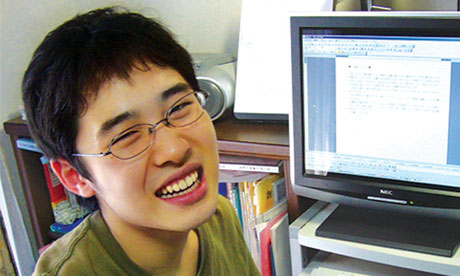
    Naoki Higashida: ‘What makes me smile is seeing ­something beautiful.’ Photograph: Miki Higashida

    When I was small, I didn't even know I had special needs. How did I find out? By other people telling me I was different and that this was a problem. True enough. It was very hard for me to act like a normal person, and even now I still can't "do" a real conversation. I have no problem reading books aloud and singing, but as soon as I try to speak with someone, my words just vanish. I can't respond appropriately when I'm told to do something, and whenever I get nervous I run off from wherever I happen to be. So even a straightforward activity like shopping can be really challenging if I'm tackling it on my own.
    During my frustrating, miserable, helpless days, I've started imagining what it would be like if everyone was autistic. If autism was regarded simply as a personality type, things would be so much easier. Thanks to training, I've learned a method of communication via writing. Problem is, many children with autism don't have the means to express themselves, and often even their own parents don't have a clue what they might be thinking. So my big hope is that I can help a bit by explaining, in my own way, what's going on in the minds of people with autism.
    Why do people with autism talk so loudly and weirdly?
    People often tell me that when I'm talking to myself my voice is really loud, even though my voice at other times is way too soft. This is one of those things I can't control. It really gets me down.
    When I'm talking in a weird voice, I'm not doing it on purpose. Sure, there are times when I find the sound of my own voice comforting, when I'll use familiar words or easy-to-say phrases. But the voice I can't control is different. This one blurts out, not because I want it to: it's more like a reflex. When my weird voice gets triggered, it's almost impossible to hold it back – if I try, it hurts, almost as if I'm strangling my own throat.
    Why do you ask the same questions over and over?
    It's true, I always ask the same questions. "What day is it today?" or "Is it a school day tomorrow?" The reason? I very quickly forget what it is I've just heard. Inside my head there isn't such a big difference between what I was told just now and what I heard long ago.
    I imagine a normal person's memory is arranged continuously, like a line. My memory, however, is more like a pool of dots. I'm always "picking up" these dots – by asking my questions – so I can arrive back at the memory that the dots represent.
    But there's another reason for our repeated questioning: it lets us play with words. We aren't good at conversation, and however hard we try, we'll never speak as effortlessly as you do. The big exception, however, is words or phrases we're very familiar with. Repeating these is great fun. It's like a game of catch. Unlike the words we're ordered to say, repeating questions we already know the answers to can be a pleasure – it's playing with sound and rhythm.
    Why do you do things you shouldn't, even when you've been told a million times not to?
    It may look as if we're being bad out of naughtiness, but honestly, we're not. When we're being told off, we feel terrible that yet again we've done what we've been told not to. But when the chance comes once more, we've pretty much forgotten about the last time. It's as if something that isn't us is urging us on.
    You must be thinking: "Is he never going to learn?" We know we're making you sad and upset, but it's as  if we don't have any say in it. Please, whatever you do, don't give up on us. We need your help.
    Do you prefer to be on your own?
    I can't believe that anyone born as a human being really wants to be left all on their own. What we're anxious about is that we're causing trouble for the rest of you, or even getting on your nerves. This is why it's hard for us to stay around other people.
    The truth is, we'd love to be with other people. But because things never, ever go right, we end up getting used to being alone. Whenever I overhear someone remark how much I prefer being on my own, it makes me feel desperately lonely. It's as if they're deliberately giving me the cold shoulder.
    Why do you make a huge fuss over tiny mistakes?
    When I see I've made a mistake, my mind shuts down. I cry, I scream, I make a huge fuss, and I just can't think straight about anything any more. However tiny the mistake, for me it's a massive deal. For example, when I pour water into a glass, I can't stand it if I spill even a drop.
    It must be hard for you to understand why this could make me so unhappy. And even to me, I know really that it's not such a big deal. But it's almost impossible for me to keep my emotions contained. Once I've made a mistake, the fact of it starts rushing towards me like a tsunami. I get swallowed up in the moment, and can't tell the right response from the wrong response. To get away, I'll do anything. Crying, screaming and throwing things, hitting out even… Finally, finally, I'll calm down and come back to myself. Then I see no sign of the tsunami attack – only the wreckage I've made. And when I see that, I hate myself.
    Why do you repeat certain actions again and again?
    It's like our brains keep sending out the same order, time and time again. Then, while we're repeating the action, we get to feel really good and incredibly comforted.
    I feel a deep envy of people who can know what their own minds are saying, and who have the power to act accordingly. My brain is always sending me off on little missions, whether or not I want to do them. And if I don't obey, then I have to fight a feeling of horror. For people with autism, living itself is a battle.
    Why are your facial expressions so limited?
    Our expressions only seem limited because you think differently from us. It's troubled me for quite a while that I can't laugh along when everyone else is. For a person with autism, the idea of what's fun or funny doesn't match yours, I guess. More than that, there are times when situations feel downright hopeless to us – our daily lives are so full of tough stuff to tackle. At other times, if we're surprised, or feel tense or embarrassed, we just freeze up and become unable to show any emotion whatsoever.
    Criticising people, winding them up, making idiots of them or fooling them doesn't make people with autism laugh. What makes us smile from the inside is seeing something beautiful, or a memory that makes us laugh. This generally happens when there's nobody watching us. And at night, on our own, we might burst out laughing underneath the duvet, or roar with laughter in an empty room… When we don't need to think about other people or anything else, that's when we wear our natural expressions.

    SOURCE